Showing posts with label CNN. Show all posts
Monday, August 2, 2021 0 comments

Reinventing the Wheel

You may not remember that foreign actor intervention was the primary headline from the 2020 presidential election.

That's because the headlines have been much different.  Suspected foreign intervention was the theme of the 2016 election and I took personal criticism for focusing on what I considered, instead, to be the true election administration issues leading into the 2018 election--the fundamentals, the proverbial blocking and tackling of election administration..

While suspected foreign intervention was a theme in 2016, that didn't even become a "thing" until early August of that year.  Similarly, COVID didn't emerge as a potential backdrop to the last presidential election until March of 2020.

In training election workers, I often noted how we always train on the LAST issue, whether or not it was the most important.  A training issue that emerged from an August election, for instance, usually didn't turn out to be the issue in November.  We made sure of that.

Never worry, that slip that wasn't signed by two election workers, or the proper completion of the provisional envelopes--we nailed that previous problem, only to have a new issue in the next election.

Superstitions exists with elections.  If we slayed a third potential operational dragon, pre-election, in Johnson County, Kansas, we took relief that the third and final issue was solved because, surely, three was the magic number of potential roadblocks in any election.

Operational issues are always the most important election issues.  There may be no such thing as a perfect election, but local election administrators will never accept such talk, always looking to prepare for a string of perfection.

I remember sitting in the office of a local election official on election day in November 2018, where he told me foreign influence was the biggest issue election officials were facing then, that very day, and as we headed into 2020.

"Is it?," I asked.  "Is it more important than making sure people today get to the right polling place, or they receive the proper ballot, or those who voted in advance get their ballots returned, or the college student who didn't get her ballot..."

I maintained, and I think 2020 bore out, that the old and boring election operations issues are always the most important.  In fact, if any of those issues arose, some may wonder if foreign intervention was the behind-the-scenes culprit.  So, in a slight nod to that local administrator's point from 2018, suspected foreign intervention made operational issues even more important than ever.

I'm not discounting the need to address foreign security threats, but if all politics are local, as the cliché goes, all election issues could be considered local as well.

In fact, it's common for a local election official to hear from a voter, "I don't worry about how elections are ran here, but I worry about how they are run elsewhere."

That's good and bad, I suppose, but reflects that local election officials know that the success of an election comes down to handling hundreds of details.  Local election officials handle those details incredibly well.

Now that I've been a state election official for almost two years, and with no offense intended to my new peers because this job has its own balls of stress, all-in-all, local election officials bear much more election-day stress.

(And my time as a federal elections official.....well, that just makes me recall one of my favorite phrases-- "Where the Rubber Meets the Sky").

Local election officials are the true heroes.

I don't use that term lightly.  I just know first-hand the immense pressure upon them, the exhausting hours they put in, and the scrutiny upon them in times of close elections.  Two assistant election commissioners died from cancer and another recovered from major cancer surgery during my time in Johnson County, Kansas.  My Johnson County predecessor is a cancer survivor.  Local election officials literally give their health and years of their lives to serve voters. 

Compared to their peer department heads in county government, for instance, the risk is much greater.  I often said that a bad day for the Public Works director is a pothole and a bad day for me as Election Commissioner would have me on CNN.

Fun Fact #1--I have been on CNN in a good way.  They spent the day with me in November 2014.  This link has the interview summing that up, where I relayed that they were like family during that visit.

It was a fun day.  "Wolf's gonna love that," is the memorable quote from that election.

But, usually, network news is not a place where election administrators want to be.  Close elections become very emotional and if the outcome isn't ideal, it's easy, as in sports, to blame the referee. Election administrators, as a whole, do a great job and are the least political people you will ever meet.

I've tried to capture the different elements local administrators face by creating a wheel of competencies.  The picture here is the third generation, after fiddling with it at the U.S. Election Assistance Commission to have the events follow chronological order of an election, and then modifying when coming to North Dakota because North Dakota, while managing a central voter file, is the only state in the country without voter registration.

Fun Fact #2--When you get down to it, voter registration is an unnecessary burden on voters, another topic I wrote about on this blog.  I'll address this further in a future post.

Back to the wheel...by putting some activities in purple, to represent ongoing competencies that are year round, the events don't truly go round and round.  We thought about different bands of activities to keep the wheel image, but it got more confusing and looked too much like a dart board, although, in fairness, election officials  might feel like a dart board at times

The whole point of the wheel--this blog, as well--is to raise awareness of the work election officials undertake to make election day--nay, election season (a point discussed much in the coming months)--go well.

"Go well" is subjective, but if you consider that the center of all activities, rather than the nice logo here, is actually the voter, "go well" should mean that voters have the ability to easily vote and have confidence their votes were cast and recorded correctly.

Each one of these Trivial Pursuit-like slivers represents a huge component, and local election officials must be experts in each.  These aren't dimensions listed on a job description but major components that require expertise.

Over the next few months, this blog will discuss many of the themes in the wheel planks.


Tuesday, November 11, 2014 0 comments

Election Marathon

I ran a half-marathon on Sunday.

Half-Marathon Finisher Medal
I ran it because I could, a great release from what has been a grueling marathon of an election.  I hadn't trained, but I was okay with my time of 1:55 and finishing it was the win, anyway.

That real marathon ends today, with the board of canvassers reconvening at 1:30.  With about 3,000 provisional ballots to count and many having to be hand-counted partials, the special board worked 12 hours yesterday to finalize results.

That's a marathon in its own right.  These are some of our office's most dedicated part-timers, working for nearly nothing, pushing paper.

Even years bring with them many things, including a very long ballot, two-sided, 8 1/2 by 17 inches, with approximately 30 items to select.  With 190,000 voters, that's nearly 6 million voting transactions.

Even years also bring a long October, one which doesn't allow for training for such things as real marathons.  I ran my only marathon in 2013.  I'm not sure I'll run another, but I knew I wouldn't run one in 2014. Besides, we had election worker training the day of the Kansas City Marathon.

Election Results, Halfway From Finishing, on CNN
We had our own virtual marathon at the office, though.  In fact, all of Kansas City had the World Series run for the Royals that was exhausting, and we didn't even play the games.  The post-season ran the entire month of October and held the city captive.  Who knew October baseball really now lasts all of October?

It hasn't always been that way.

Baseball great Reggie Jackson referred to himself as Mr. October and as a kid, I thought that was a silly nickname because the World Series ended halfway through the month.  I ran a half-marathon, but I'm not Mr. Marathon.  Why wasn't he Mr. Half-October?  Or, Mr. Late Summer?  Or, Mr. 30-Days-Some-In-September-Some-In-October?

Anyway, there definitely was a Royals factor to the whole election.  In training, I began giving the milestones in Royals dates--registration ended as the Royals won game 3 of the division series, advance by mail began the day they clinched that series and--oops--Supervising Judges pick up supplies the day of the victory parade (my guess on the date).

We saw advance voting in person trail off in the afternoon of game days and explode after the World Series ended.  Voters were giddy.  People were dressed in blue but if their voting experience was blue, we didn't know it.

After the Series, those things we typically see when voting is going on for two weeks began emerging.  Voters selected candidate A on a machine, for instance, but candidate B came up.  They changed it, voted accurately, but worried about all of the others who may not be as observant as them.

This has gone on since the machines were purchased, 2002--before my time, and as much as I'd like to use this as THE excuse for needing a new voting system (oh, it's an excuse, believe me), it usually happens because of pilot error.  The machines are not your father's iPads, which then just tells you how old the technology is if your father didn't even use it.

To provide some context there, the scroll bars on the review screen on the voting machines are on the LEFT.  Look at your web browser.  Note the scrolls are on the right--always have been.  Yep, we're voting with pre-Internet design.

In any event, we record whenever these anomalies are reported, and in this election it seemed to happen, as it usually does in an election, on just once race.  We had a couple of reports for governor and Secretary of State, and one on a judge, but the other 25 were on the US Senate race.

Again, I have absolutely no incentive to defend the machines, other than that I can demonstrate our testing that assures they tabulate perfectly.  I didn't select the machines, I want a new system, and I have no problem throwing the machines under the bus, except that the machines would probably cause the bus to crash, and while unlikely around here, someone might be on a bus and be hurt.  That would be bad.

But if it was a simple case of bad calibration, many of the races would have this issue.  At the very least, the races in the same place on the screen, as voters advance, would experience the same thing, on screen two, screen three, and screen four.  30 reports out of nearly 6 million transactions don't lead to a widespread diagnosis of poor calibration.

The reports and calls suggest we equally were favoring candidates, not only suggesting that we were trying to engineer the election but also that those Palm Pilot devices had the capability of guessing who the voter wanted in a race and then forcing the other candidate's name to be selected.

I heard about these reports, often the same report from different sources, through many poll agents and lawyers.  I talked to only two angry voters on election day, mostly because I was on the phone with other stakeholders the rest of the day.  We had media throughout the day, and with a position that had gone a year to fill not yet filled until yesterday (woo hoo!) and the sad loss of our assistant election commissioner over election workers and polling places, being understaffed took its toll in terms of my availability on election day.

I was so excited to talk to these actual voters that they probably wondered if they were being punk'd.

We had some key learnings in this election:

  1. We have consolidated polling places for the last time.  We had the fewest, 182, we've had in a November election and in 2016, we'll need at least 75 more.
  2. We won't get to 250 polling places, let alone 284 that we had in 2008.  They just won't be available.
  3. We will need more advance sites.
  4. We won't get those either, with the economy improving and storefronts filling, without paying excessive rent.
  5. My reaction to these issues is, "So?"  These are elections.  These are real cost issues, including staffing needs and election worker pay increases that are needed.  My job is to administer the elections and the county's role, very harshly, is to fund it.  I expect the 2016 cost to be at least $1 million more than it was this year, at least.  This is not my problem.  It is a problem, for sure, only to get worse with the funding of our voting system.  But there is a huge expense ahead to be adequately prepared for 2016.
And, finally, we had the learning of the poll agents--about 400 deployed in this election.

Imagine, instead, if just half of them had been election workers.  We'd have had one more worker per polling place and then some.

Now, back to running the half-marathon.  I like running races and I pay for that.  Similarly, I played indoor soccer for years.  I like participating in competitive events.

As a competitor, I've had my share of times that I felt, for instance, that the soccer referees could have been better.  But the idea of becoming a referee myself--no thank you.  Just, I thought, I wish that they would hire better referees.

Likewise, I think voters deserve to carry expectations that their participation in competitive government events (elections) are handled professionally.  Voters pay entry fees (taxes) to have voting convenient, and never would I suggest to a voter who is unhappy that if the voter really cared, the voter should get more involved in the process, to be one of our referees.

But I would make such an appeal to poll agents.  In fact, I plan to do that very thing.  One area we will target, for new workers, will be the poll agents.

If someone has made the leap to assist with a campaign or candidate, and had time on election day to monitor the process, the best way they could help the process is to be part of it, as an election worker.

We're fortunate that these 400 were engaged.  Now, we hope to engage them further for the marathon ahead in 2016.


Sunday, November 2, 2014 2 comments

This is CNN

As always, there is much more to update that time allows, but as we head into the last day before the election, at the very least, I wanted to make sure I quickly blogged about some sort of life imitating life event.

I'm not sure art is involved in this case, except for shirt art.  I'll explain:

Any doubt that Kansas is in the public eye on Tuesday was erased when we received a call on October 15 that CNN would be broadcasting live from our office on Tuesday.

Politico, the Washington Post, and Time magazine also will have reporters here, although the Time thing is a bit misleading.  David Von Drehle of Time lives here locally and I only know that because I sold a universal weight set a few years back and he bought it.  Again, just another part of my get-to-know-all-380,000-voters plan.  Still, I may see him professionally this week, too.

CNN will be arriving tomorrow to set up and we'll discuss their time here.  I think they'll mostly be doing a behind the scenes view of the election and, of course, that's right in the wheelhouse of this blog.

A local reporter asked if we would do anything differently with CNN coming.

I told her we'll dress better.

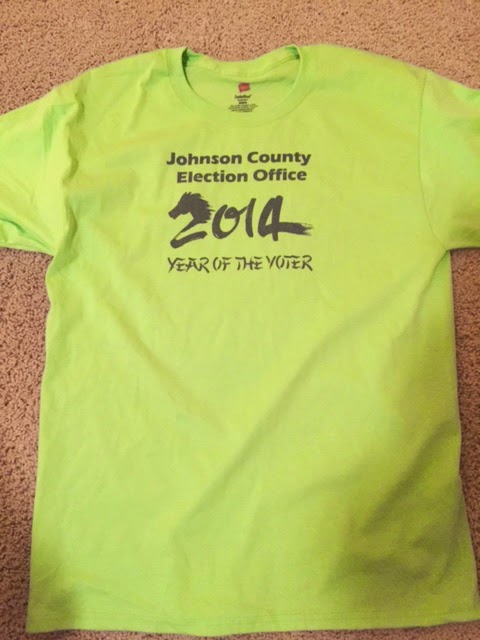
In fact, we always give our high-school election workers a t-shirt to wear at the polls so they can be properly identified and applauded by every voter they encounter.

We also use a group of Olathe North National Honor Society students to help with the check-in of equipment on election night.  They will wear the same shirts.

The back of the shirt features a hashtag, #GoVoteJoco.

We've given birth to it, hoping it lives as long as hashtags live. We thought about a QR code, but QR codes are so 2012.  The front of the shirt has 2014 on it, so we only need the hashtag community to hold on for two months.

#hashtagsforever

Also in the world of fashion, I show you a pin we give to each election worker:

We customize one for each November election and our workers proudly collect them.  In fact, in my international observation trip to Georgia last year, I took some pins from the 2010 and 2012 election and they were a huge hit with my fellow observers from around the world.

I was a little surprised.  I'm not much of a Pin Man, I guess.  But many of my peers proudly wore the pins.

So, surprised, yes.  But, also proud.

I'm further proud of our workers.  They are galvanizing for the election in the wake of losing the man who, often, hired them--Tom Ray.

I asked that they offer up the 2014 election as a prayer to Tom as we conducted supervising judge training this weekend.

For training, we broke out the interactive test-taking clickers we bought in 2012 to do polling and testing during training.  I find that asking questions before training is most effective because we see areas we need to emphasize if the group scores low on a particular item.

Besides, it's really deflating to do the questions at the end of training, only to realize we still have much work to do.

I know the question here was a bit of a creme-puff, but I've never had a group answer 100 percent correctly before!

And with that, I'll stop the post and take the win.

#TilTuesday
 
;