Showing posts with label Voter Registration. Show all posts
Monday, August 2, 2021 0 comments

Reinventing the Wheel

You may not remember that foreign actor intervention was the primary headline from the 2020 presidential election.

That's because the headlines have been much different.  Suspected foreign intervention was the theme of the 2016 election and I took personal criticism for focusing on what I considered, instead, to be the true election administration issues leading into the 2018 election--the fundamentals, the proverbial blocking and tackling of election administration..

While suspected foreign intervention was a theme in 2016, that didn't even become a "thing" until early August of that year.  Similarly, COVID didn't emerge as a potential backdrop to the last presidential election until March of 2020.

In training election workers, I often noted how we always train on the LAST issue, whether or not it was the most important.  A training issue that emerged from an August election, for instance, usually didn't turn out to be the issue in November.  We made sure of that.

Never worry, that slip that wasn't signed by two election workers, or the proper completion of the provisional envelopes--we nailed that previous problem, only to have a new issue in the next election.

Superstitions exists with elections.  If we slayed a third potential operational dragon, pre-election, in Johnson County, Kansas, we took relief that the third and final issue was solved because, surely, three was the magic number of potential roadblocks in any election.

Operational issues are always the most important election issues.  There may be no such thing as a perfect election, but local election administrators will never accept such talk, always looking to prepare for a string of perfection.

I remember sitting in the office of a local election official on election day in November 2018, where he told me foreign influence was the biggest issue election officials were facing then, that very day, and as we headed into 2020.

"Is it?," I asked.  "Is it more important than making sure people today get to the right polling place, or they receive the proper ballot, or those who voted in advance get their ballots returned, or the college student who didn't get her ballot..."

I maintained, and I think 2020 bore out, that the old and boring election operations issues are always the most important.  In fact, if any of those issues arose, some may wonder if foreign intervention was the behind-the-scenes culprit.  So, in a slight nod to that local administrator's point from 2018, suspected foreign intervention made operational issues even more important than ever.

I'm not discounting the need to address foreign security threats, but if all politics are local, as the cliché goes, all election issues could be considered local as well.

In fact, it's common for a local election official to hear from a voter, "I don't worry about how elections are ran here, but I worry about how they are run elsewhere."

That's good and bad, I suppose, but reflects that local election officials know that the success of an election comes down to handling hundreds of details.  Local election officials handle those details incredibly well.

Now that I've been a state election official for almost two years, and with no offense intended to my new peers because this job has its own balls of stress, all-in-all, local election officials bear much more election-day stress.

(And my time as a federal elections official.....well, that just makes me recall one of my favorite phrases-- "Where the Rubber Meets the Sky").

Local election officials are the true heroes.

I don't use that term lightly.  I just know first-hand the immense pressure upon them, the exhausting hours they put in, and the scrutiny upon them in times of close elections.  Two assistant election commissioners died from cancer and another recovered from major cancer surgery during my time in Johnson County, Kansas.  My Johnson County predecessor is a cancer survivor.  Local election officials literally give their health and years of their lives to serve voters. 

Compared to their peer department heads in county government, for instance, the risk is much greater.  I often said that a bad day for the Public Works director is a pothole and a bad day for me as Election Commissioner would have me on CNN.

Fun Fact #1--I have been on CNN in a good way.  They spent the day with me in November 2014.  This link has the interview summing that up, where I relayed that they were like family during that visit.

It was a fun day.  "Wolf's gonna love that," is the memorable quote from that election.

But, usually, network news is not a place where election administrators want to be.  Close elections become very emotional and if the outcome isn't ideal, it's easy, as in sports, to blame the referee. Election administrators, as a whole, do a great job and are the least political people you will ever meet.

I've tried to capture the different elements local administrators face by creating a wheel of competencies.  The picture here is the third generation, after fiddling with it at the U.S. Election Assistance Commission to have the events follow chronological order of an election, and then modifying when coming to North Dakota because North Dakota, while managing a central voter file, is the only state in the country without voter registration.

Fun Fact #2--When you get down to it, voter registration is an unnecessary burden on voters, another topic I wrote about on this blog.  I'll address this further in a future post.

Back to the wheel...by putting some activities in purple, to represent ongoing competencies that are year round, the events don't truly go round and round.  We thought about different bands of activities to keep the wheel image, but it got more confusing and looked too much like a dart board, although, in fairness, election officials  might feel like a dart board at times

The whole point of the wheel--this blog, as well--is to raise awareness of the work election officials undertake to make election day--nay, election season (a point discussed much in the coming months)--go well.

"Go well" is subjective, but if you consider that the center of all activities, rather than the nice logo here, is actually the voter, "go well" should mean that voters have the ability to easily vote and have confidence their votes were cast and recorded correctly.

Each one of these Trivial Pursuit-like slivers represents a huge component, and local election officials must be experts in each.  These aren't dimensions listed on a job description but major components that require expertise.

Over the next few months, this blog will discuss many of the themes in the wheel planks.


Tuesday, September 23, 2014 0 comments

Happy Voter Registration Day!

It's National Voter Registration Day.

The Board of County Commissioners issued a proclamation last Thursday and we had a nice time showcasing the efforts of the League of Women Voters (who pushed for the proclamation).

Beyond that, as an administrator, I'm not sure what the "day" really does except gives us a topic.  Like a sales person with a new product, National Voter Registration Day gives us a new reason to promote voter participation. 

Last night, the Lenexa Masonic Lodge hosted me and 5 of our staff members for dinner.  I spoke briefly about National Voter Registration Day but also used that moment to recruit election workers. 

The Lodge actually is part of our Adopt a Polling Place program, where members work and give their earnings as a fund-raiser to their organization.  They are building college scholarship programs with the earnings.

The program is such a win-win.  We need election workers, and this is a very efficient fund-raising concept.  The Good Shepherd Knights of Columbus has pretty much adopted two places with about a dozen members working.

I'm biased, but I think it sure beats working a concession stand at the Chiefs game, in dollars, patriotism, and workload (I said workload, not stressload).   Plus, there's never Tuesday Night Football, which means election workers don't miss a key game by working.

One of the Best Practice Awards at the recent Election Center conference was a program with the this same theme, focused on getting companies to participate.  The clever twist from that program was that the election office helped companies with an election of some sort (like the mock elections we do for kids, but with adults, asking them, for instance, their preference for a company promotion or advertisement).  This got the adults engaged as potential workers.  It's a concept we plan to---wait for it---adopt ourselves.

It was in Franklin County, Ohio.  Here was their booth that presented the award:


Sunday, September 22, 2013 0 comments

There Are Returned Ballots, and Then There Are "Returned" Ballots

Our Overland Park mail-ballot election--the biggest mail-ballot election in the county's history--is underway!

The process, utilizing Pitney Bowes in Kansas City and bypassing the Olathe Post Office to send the ballots, has been incredibly better than our experience the last time (2008) we had an Overland Park mail-ballot election.

I couldn't take photos at Pitney Bowes on Monday because of their own security, but here are some of the pallets awaiting shipment from Washington state, where we have them printed by ES&S.  Once arrived at Kansas City, they were sorted by zip code and prepared to be taken to the Kansas City Post Office Tuesday night, and voters began receiving their ballots Wednesday morning.

By law, the ballots couldn't begin being received by voters until Wednesday.

We have another large mail-ballot election, in Olathe, on the heels of this one, and beginning with that election, we'll have a tracking system in place so that we will know when ballots are at the Olathe Post Office, awaiting delivery to us.  That has been an issue, where we have been told by the Post Office that they had no ballots on a Tuesday morning, only to find that they actually had a few hundred but simply hadn't counted them yet.

Ballots were mailed Tuesday night, began being received Wednesday, and by Friday, we had 10,151 ballots returned.

However, of the those, 5,994 were returned by the voter as voted ballots.  4,157 were returned as undeliverable.

"Returned" ballots.  Green envelopes are
returned, voted ballots.  White envelopes
are returned as undeliverable.  Ballots
cannot be forwarded.
This means that of the 111,069 ballots issued, 3.7 percent represented voters who have moved just since March.

That's when we mailed postcards to each voter and began working those that came back undeliverable.  Those voters became "inactive," where they sit unless we get a good address and updated registration or until they haven't voted in both the 2014 or 2016 federal election.  At that point, if they are still inactive in December 2016, they can be removed.

Mail-ballot elections only send ballots to active voters in Kansas, so none of those returned were already in inactive status.

Using the 3.7 percent as a swag and recognizing that it's been only six month since the postcard, it's fair to think that at least 7 percent of voters move without updating their registration annually.  With 370,000 registered voters, beyond those we know are inactive, that's about another 26,000 who, theoretically, will have moved and not updated their registration in a 12-month period.

This is especially complicated for a county like Johnson County, which sits on a state line.  Many of these voters likely will have moved to Missouri.  In fact, that also complicates the issue of the voters in suspense status who have registered but not yet provided proof of citizenship.  Some of those voters, nine months into the implementation of the law, have likely by now moved out of state and will remain in that suspense status indefinitely.

There has to be a better way of managing the voter rolls.  In fact, there are better ways.

That sentence was intended to say that there HAS to be a better way, meaning implementing the better way may be one way out of that continuing War on the Voter that we fight as polling places are eliminated, advance voting sites are difficult to find, and the mail service--without the crafty end run we just did for Overland Park--continues to be a worry.

Both the PEW Center for the States and the Kansas Secretary of State testified on this issue Friday to the Presidential Commission on Election Administration.

What was done after the Help America Vote Act, to create statewide voter registration systems, should be amped up, in my opinion.  I sat next to one of the co-chairs of the Commission during a meeting in early July and he had a keen interest in the solutions implemented by PEW and the state of Kansas.

PEW's solution is a comprehensive voter registration system that incorporates several databases.  Kansas has agreements with nearly half of the states in the country to compare voter registration lists and remove duplicates.

I'm hoping that because this issue seemed to be burning since at least early July with the Commission, some tangible change may result, perhaps in the year or two after the recommendations are made (by December).

One nationwide voter registration system may be too much to undertake politically, but it would go a long way to keeping us from putting an asterisk after the definition of "returned ballots."  It may also be a gateway to more innovative voting methods, such as allowing voters to call up and cast their unique ballots anywhere in a state or even anywhere in the country.

For now, we'll take the short-term win.  For Overland Park, thanks to sweat on the backs of many at ES&S, Pitney Bowes, the U.S. Post Office (our guy on the case in Kansas City), and our own employees at the Election Office, this election has started off very smoothly.

Tuesday, September 17, 2013 0 comments

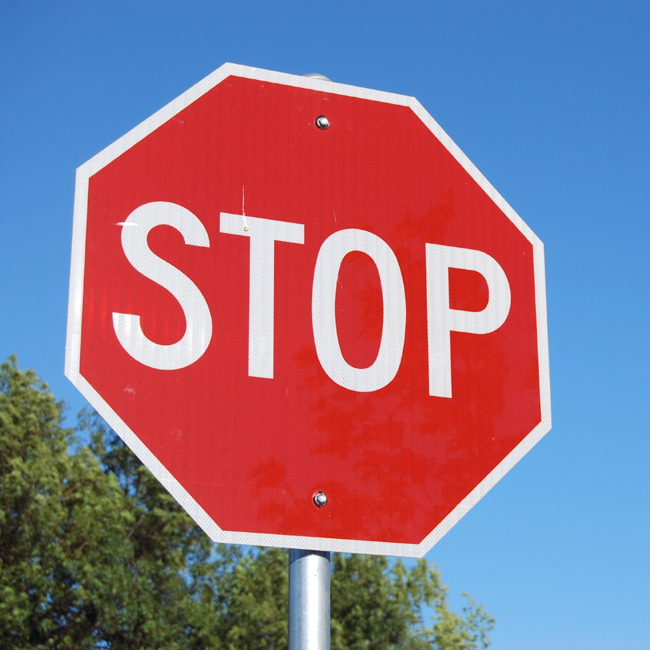
Grandma's Stop Sign Analogy

Several years ago, a 12-year-old girl was hit by a car when crossing a four-lane street to get to our neighborhood swimming pool.

The subdivision developer's design, approved by our city, had the pool with about 50 homes on one side of the street while about 250 homes were on the other side.  The struck pedestrian was an inevitable outcome.

I successfully lobbied the city to install a 4-way stop sign at that intersection.  It may be a pain for drivers, but, I guess, bad planning begets more bad planning. Hundreds of people safely cross that intersection each year with no reports of anyone being struck by a car over the last decade.

But, imagine it didn't go exactly that way.

Imagine, just as occurred, there was a neighborhood meeting that I, as an interested homeowner, attended.  During this meeting, I passed out a Powerpoint presentation (all things in life come down to Powerpoint) that analyzed the benefits of doing nothing, a four-way stop, or a traffic signal.

I pushed for a traffic signal, but some residents thought that might invite other problems, and the stop-sign momentum was on.

Because I was the guy with the Powerpoint, I became the defacto leader of this movement.  Most residents who were at that meeting attended the city council hearing with me in support of this proposed legal change.  We filled the city council chamber that evening.

Imagine, just as occurred, that the city council approved this four-way stop sign.  The city's top elected official, the mayor, proclaimed this as a positive thing.

Then, suppose (as didn't occur), that the public works department appeared to have only installed one more sign, essentially creating a three-way stop.  All of us wondered why the law as passed wasn't implemented and, thus, wasn't working.

We heard varying stories.  A system issue prevented creation of the fourth stop sign.  We heard it was a training issue.  We heard that some motorists stopped and others didn't.  There was a rumor that the stop sign was installed but it just wasn't visible, hidden behind a tall tree.

All the while, angry homeowners wanted answers.  They were all directed to me.  It had been my idea, this four-way stop, and the implementation wasn't working.

Never mind that I could do nothing about it and the governing body had approved my recommendation.  This "three-way stop" was my fault.

The local paper called and asked if there was any progress in reducing the number of people crossing the street on the unmarked side.  I explained that until this intersection looked completely like a four-way stop, this would continue. The city's public works department publicly stated that it had executed the new ordinance properly, and even left fliers with all homeowners explaining that the best way to cross the street was where the third stop-sign was visible.

Continue to suppose that this stop sign solution didn't reduce the number of near-misses of cars hitting pedestrians.  In some ways, this new solution, some thought, discouraged pedestrians from going near the intersection.  Some predicted that the use of the pool would drop.  This was October, though, and the next pool season was months away, so only those most invested in this intersection issue were engaged.  It was predicted that this would heat up when the pool opened next year.

All the while, every day, I received complaints.  True, I pushed for a solution that the elected officials voted on, and passed, but the solution did not resemble what was approved.  The city council president expressed his dismay with the public works department, but the public works department indirectly reported to the mayor, who actually referred upset residents back to me.

This yarn is about as close as I can come to explain what we are living through right now regarding implementation of the citizenship requirements of the Secure and Fair Election Act, passed in 2011 by the Kansas legislature and signed into law by the governor.

There are about 17,000 voters in suspense status throughout the state because they have registered at the driver's license bureau but that agency, for reasons that aren't clear, hasn't forwarded on the voter's proof citizenship paperwork or noted on the record that this paperwork was displayed.

Some of these cases happen when voters go online to change an address for their driver's licenses, we are told, but actually people already registered in Kansas on January 1 don't need to produce proof of citizenship documents when re-registering at a different address.

In Johnson County, we have about 3,000 of these voters.  We mail letters to them and have a robocall to them at the first of each month.  Most haven't responded, perhaps because there isn't a major election still for a year.

When we do talk to one of these voters, we usually find that they showed their birth certificate when registering or offered to do so and were told they didn't need to.  Early in the year, we were told that a system issue was preventing us from receiving what we needed.

"The Department of Revenue's systems weren't ready and this law should have been delayed until they were," we were told by a former legislator and an activist against the citizenship requirement.  However, there is nothing to suggest that this IS a systems issue according to the article in The Kansas City Star today.

We're not really sure what the issue is, except that we know we can't solve it.  The Secretary of State's office can't "solve it" either.  True, the Secretary of State pushed for this citizenship requirement after being elected, ostensibly because this was part of his platform.

It was his "idea," much like the stop sign was my idea, but the idea became law, passed by a majority.  Just as in my stop-sign analogy, the legislative committee chambers were standing-room only, primarily with supporters, when the bill was reviewed in early 2011.  The governor, much like the mayor in my stop-sign story, hailed the measure as he signed it into law.

Akin to my public works example, the only agency that can solve this issue is the one required in the legislation to implement the law--the Department of Revenue's driver's license bureau.

As election administrators, many of us have seen uneven implementation of the "Motor Voter" law, the National Voter Registration Act, that allows for persons to register to vote when applying for services at other state agencies, such as when getting a driver's license.

We had some of these uneven moments in 2008 when an electronic transfer of records was created between the driver's license bureau and the Secretary of State's office, but since then things have been pretty smooth leading into this current issue.

But this is an issue and, like my stop sign story, one that requires the agency required to implement it to address.  Pool season will be upon us soon.


Thursday, August 22, 2013 0 comments

In the News

I was a newshound even as a kid so I enjoyed the Kansas City Star's Mini Page and actually liked CBS's "In the News" segments on Saturdays.

This is a post in that spirit.

First, this past week, this very blog was awarded an industry Best Practice by the Election Center. My hometown paper even picked up the press release.

As gratifying as that was, my bigger observation was that of the six Best Practice awards given by the Association in 2013, two were related to tablet computers. And, not just any tablet computers: they utilized iPads.

Our office had already received a "Bright Ideas" award this year from Harvard University for our use of iPads at the polls.

These are devices that have been around only for about 40 months and now are a major piece of our culture. A minor piece of my spirit was bitten off last year by our county manager's office for equipping our employees with iPads during the presidential election cycle, but I knew it was the right decision and now most of our staff (and many knowledge workers in government and business) can't imagine working without them.

As evidenced by the innovative awards and uses--as well as the increase of electronic poll book use--iPads, and tablets in general, are obviously now a visible cog in the innovation cycle in elections and government.

When looking at the future uses of iPads, that consideration abruptly leads to Android tablets, which collectively outnumber iPads. In fact, (and I saw this again and again when I was at Sprint) companies have a way of gravitating to their natural market position, and it's very likely the iPad will become, over time, the niche player in tablets in much the same way the Mac is still a niche player in computers.

The Wall Street Journal recently postulated what that might mean for Apple. iPads could be the Blackberry devices of this decade, virtually gone by 2020. It's an important consideration, especially as tablet devices worm their way into more parts of the election process.

That's a whole 'nother post later, but a factor that will come into play with our next-generation voting system analysis.

Also in the Wall Street Journal was a recent update on the United States Postal Service's money woes. Since 2005, the article points out, first-class mail has declined by approximately 30 percent.

By comparison, in 2005, we sent out 85,000 first-class mail-ballots and this year will be sending approximately 300,000.  That's about a 250 percent increase.  Our communities are business-development engines for the Post Office in a time when the postal service is compressing.

If there is ever a living example of "Nero fiddled while Rome burned," it's the postal service. In fact, I think the postal service is in a fiddle jam session with the newspaper industry.

Maybe Amazon's Jeff Bezos will try to buy the postal service. There is a huge piece of synergy there.

Point is, everyone seems to see only one path for the postal service--reduced service and some sort of government bailout.  It's interesting that no one sees a path where the postal service succeeds.  Even the postal service doesn't see that path, although in meetings often I hear them say that they think they are succeeding today.  (Charlie Sheen's "Winning" comes to mind).

What if there is another path?  What if the postal service is privatized?  One way to improve the postal model is to make it market-driven.  The postal service already is the last mile often for Amazon, even though the packages go out through UPS.  It's possible that a shift in focus, and better management, could change things dramatically.

Short of that, I'm continually amazed at how a business can be in such a tailspin and either seem oblivious or unwilling to actually correct the course. You'd think the postal service would have sales managers regularly calling on communities that regularly have mail-ballot elections, or an aggressive vertical marketing campaign directed at elections.

The postal service does spend money on advertising, but those marketing efforts are very unfocused and likely do not provide a good, um, return.

Lastly in the news this week is an article related to the new health care exchanges and voter registration.

This article, to me, is less important than the secondary issue that comes to mind.

We live in an age where various government entities touch us in a largely uncoordinated fashion. Yet, many of these--as stated in the article--are supposed to work together on our behalf. That doesn't work out well.

In Kansas, we're dealing with registration issues because we aren't receiving paperwork from the driver's license bureau, and data supports that this is something nearly every state sees except for Michigan, where the driver's license bureau and voter registration line up under one state officer.

I get the concerns in light of the recent NSA privacy concerns, but I think voters would benefit, for instance, with the Michigan model or even something more far-reaching.   For instance, if an identity card will be needed for a health care exchange, I think there is great value in considering one state officer in charge of "identity management."

Again, I know how creepy that phrase seems. But, imagine having one place to take care of your interactions with government, at least at a state level.

Often I hear of government conspiracies and I have to point out to the person raising the issue that, based on my nine years in government, my observation is that government isn't smart enough to pull off a conspiracy.

However, a big reason they believe conspiracy theories is the notion that there is one government, not separate city, school, state, county, and federal governments.

Further, citizens don't understand why they have to provide the same information to several agencies.  It's akin to being asking for your credit card number when you finally get to a live customer service agent at Visa, even though you entered it already once on your phone.

This has come up, in different ways, at a couple of meetings I've been to recently, and I think there are some creative ways to address this, even without reorganizing.  But they all require the "give a darn meter" to be raised with officials who are as incentivized to do so as the postal service leadership is to improve the postal service's financial performance.

Harkening back gain to my Sprint days, when the market landscape changed, three things would happen:  AT&T would change its price, MCI would change its marketing message, and Sprint would reorganize.

This almost ensured we would remain number three in the market, but the inward focus also addressed customer service issues.  A customer once said, "You guys treat customer service like an art."  That's how we felt, too.

(By way, he was talking about large business support, not what we would see later--and what I believe is being fixed--on the consumer wireline side).

I think states that organize around the citizen, with a single person accountable for records, would feel the payoff.  I know our office would.
Sunday, October 21, 2012 0 comments

People Move, The Sequel

In July, I had a post featuring returned postcards that we mailed in advance of the August primary.

Two-thirds of the county's voters already had at least one election 2012 before that mailing (thus, a previous mailing), and yet we had thousands of postcards returned as undeliverable.

We worked all of those, either making the voter inactive or updating the voter's registration.  Theoretically, every voter in Johnson County was confirmed with a current address in July.

Then, with our election, we had more than 1,000 provisional ballots that again required updating of voter records.  Many of these were from voter moves, so, again, in August, every voter in Johnson County was confirmed with a current address.

Two months later, last Friday, we mailed a postcard to active voters who were not on the permanent sick and disabled ballot list.  Of our roughly 370,000 voters at the time, the postcard went to approximately 330,000, all verified at their address less than 60 days before.

As promised, here's a snapshot of how many have come back undeliverable:


This provides some perspective about how many transactions and registrations we handle.  A 30,000-voter increase in our rolls this year, 10 percent, results in nearly 100,000 activities to remove, update, or add voters, netting 30,000.

For fun, I've added below the photo from the earlier post in July.  You'll see we have eight trays back now and only had seven then!


Keep in mind we have the same staff size that existed 20 years ago, when we had 150,000 fewer voters, and you're likely beginning to see why photo ID never cracked the top 10 in terms of operational issues we've had to work through in 2012.
Tuesday, September 25, 2012 0 comments

National Voter Registration Day

42 Days to Election Day

Perhaps to the surprise of no one and as proof that there is a day for everything, today is National Voter Registration Day.

I registered to vote in 1980 and haven't changed my registration for at least 15 years, so I'm not sure how to participate individually.  Professionally, it's a little hard to do too much today, either, other than ring a bell whenever anyone comes into our office.

My license plate on my car says, "VOTE," and I'd argue that voting day is more important than registration day, but it is quite the bummer to go to vote, only to find you aren't registered, so I'm down with the concept. 

Still, "REGISTER TO VOTE" won't fit on a plate and thank goodness I was able to get "VOTE" (our state has moved to one vanity phrase among all counties), because "REG2VOTE" wouldn't feel cool at all.  My family doesn't exactly feel cool with "VOTE," but I believe that actually shows how uncool they are.

But, here at the office, our big excitement recently was a visit yesterday from Elisabeth MacNamara, the national president of the League of Women Voters.  She toured our office and warehouse and given that the League conducts voter registration drives, there was a geeky connection to National Voter Registration Day.

Still, given that about 25 percent of those registered in Johnson County won't vote on November 6, I'm going to hold onto the thought that a National Vote Day could be played up a little more.

We're getting ready.  Our paper ballots for advance voting by mail came yesterday as well, topped with little safety cones to ensure safe handling.  The pallets look like cars heading for maintenance at a dealership's service center.

We have them back earlier than normal.  I can't remember an election where our ballots came under such calm conditions.  We were due for something like that--hopefully it continues!
Sunday, January 22, 2012 2 comments

Wet Signatures

Is there an election administrator term any more geeky than "wet signature?"

The term means an actual, physical signature, as in, "with ink."  Get it?  Ink is wet.

Most election jurisdictions, including Kansas and the Department of Defense (for military and overseas voters), require a wet signature on the voter registration form.  That's why voters can't go to our website, complete a registration online, hit "submit," and call it done.

Instead, they must print off the form and sign it, then mail, fax, or scan and email it.  Some drop it off in person, old school.

We were the first election office in Kansas to begin accepting faxed and scanned registrations after getting permission from the Secretary of State's office.  There is a drawback to accepting anything faxed; primarily, if the voter faxed the form upside down, the voter has a confirmation that the fax went through and we have a blank piece of paper with no idea how to contact the person who now thinks he or she is registered.

That will be an issue when voters begin faxing photo identification for advance voting or when citizenship verification goes into effect next year.  I expect we will get a lot of faxes that have black boxes where the photos were.

PDF Expert, an iPad Application
that makes wet signatures dry
So, in those cases, email is better.

We set this all up around the Dark Ages of technology, back around the 2008 presidential election, before iPads even existed (I was the first kid on the block to get one on the day they came out and believe it or not that was less than two years ago, April 2010).

Why does that matter?  Well, now there is an app and I'm sure many more coming that push the, um, email envelope.  The app, PDF expert, allows voters to complete a voter registration form, for instance, and sign it with their finger or a stylus.  Then, the voter can email that application to us.

So, is that a wet signature?  Probably, although if this catches on, election geeks will have to huddle for a new phrase.  Jargon is hard to come by in the election world, and many eyes will be wet if this phrase goes away.

We received our first registration that looks like it came through this way.  Here's the rub, though--signing your name with your index finger on a piece of glass looks a lot different than your signature with a pen on a piece of paper.  We check signatures on advance voting applications and on mail-ballots against the registration signature.  Likely, some of these signatures won't match the PDF Expert version.

Our recommendation to anyone using this new technology is to sign their name with a stylus, as well use as a steady hand holding the iPad.
 
;