Saturday, March 11, 2023 0 comments

Strength...the Kryptonite to Cancer, and Everything Else

This a follow-up to the previous post, “Cancer!”
I’m mindful that this blog isn’t a personal column but rather a behind-the-scenes view of election administration, but an update is relevant for a couple of reasons.
First, Dear Reader, never discount the power of love and prayers.
The visible responses on LinkedIn and Facebook are only a small portion of the “Save Ferris” moments me and my family experienced.
I entered this process determined to be as physically strong as possible and of the right attitude for a recovery.  I knew I was on a conveyor belt about to take me through something of which I had no perspective or control.
The outpouring I received was inspiring.
The first jaw-dropping experience came days into my cancer diagnosis, before the blog post.
I signed up to participate in a half-marathon, part of the Bismarck Marathon in September, to get the early-bird best rate just after January 1.  It would be my first half-marathon in 7 years.
When I was met with the cancer diagnosis a few days later, I realized that training for a half-marathon was a longshot at best.  I emailed the event organizer to ask if I could, if necessary, move my registration to a 5k or 10k, and explained why I was making the request.
The answer I quickly received, from Will, one of the managers of the race and the contact for sending me my swag after running the “Santa Run” virtually in December, was, “of course.”

The next day, my wife answered the door and was greeted with flowers and a card from Will, expressing best wishes for the challenge ahead.
Keep in mind this was from someone whom I have never met. 
And that, Dear Reader, is North Dakota!
Coworkers were amazing, both at the Secretary of State’s office and at North Dakota’s IT Department, where my wife works.  My children, their families, and my mother-in-law all provided tremendous support and inspiration.
Then, there are all of you who read the previous post and commented or sent notes.  That all made a huge difference.

So, here’s the rundown and result:
  • Diagnosis, January 5, 
  • Blog post, February 4,
  • Surgery, February 8,
  • Released from the hospital, February 11
  • Surgeon follow-up March 3 and Oncologist follow-up March 5, resulting in an “all clear,” and,
  • March 8, one month from the day of the surgery, I ran a slow 5k on the treadmill.
These two months have just about been the longest year of my life.

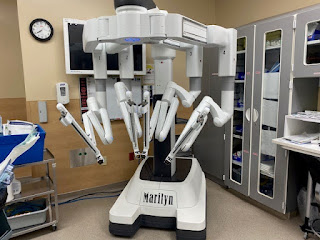
The surgery was robotic, but still fairly brutal, resulting in 19 inches, or about 1/3, of my large intestine removed and three nights in the hospital before getting the nod from the on-call surgeon to allow me to go home in time to see the Chiefs win the Super Bowl.
Consistent with the “behind the scenes,” theme, I asked the surgery team as I was wheeled in to the operating room, if they could take photos of the robotic tool that was used for my four-hour surgery.  I have no idea why it is called Marilyn.
I now will have regular CT scans and bloodwork to monitor things, but no chemotherapy!
So, there it is.  Your prayers, gifts, and messages enabled me to push this cancer away!
Still, as I’ve typed here often, cancer, in my view, comes calling for those who work in elections.
As I convalesced, I was presented with a potential career transition, and I made the decision to make myself harder to find for any potential future Cancer visit.
I’m moving out of elections, still in North Dakota state government, next week.
What better time than a moment of upheaval to keep making life decisions…
In addition, I have many plans for either eventual or mythical books to write, and these last few years can be summed up by my working title, “How the Federal Government Destroyed Voter Confidence, and What Can Be Done to Get it Back.”
That’s because everything in election administration eventually is politicized.
I recall going to the Election Center’s Joint Election Official Legislative Conference in 2006, where then Executive Director Doug Lewis held up a USA Today with a front-page article explaining that both major political parties were targeting Secretaries of State races.
Doug lamented what a bad indicator this was for elections.  I was fairly  new to elections and “then me” hadn’t yet seen what “now me” has.  Doug was spot on, and partisanship in election administration has become sequentially worse each year.
Much of the harm, in my view, has come from Washington D.C., Congress and Non-Government Organizations, social media, activists who work under the cover of alternative media, tech companies, and industry consultants and experts who move from organization to organization and require industry angst to appear relevant.
Finally, while on the subject of Secretaries, and me moving on from elections, I’ve had the privilege of working under five of them:

  1. Kansas Secretary of State Ron Thornburgh—there is no greater example of a throwback Secretary in my view then Ron; I never heard him saying anything political. 
  2.  Kansas Secretary of State Chris Biggs—the only Democratic Secretary in this list, and he believed in me, reappointing me just before the August 2010 primary, amidst those in his party suggesting the need to have “their person” in that role.  He saw the partisan aspect and also understood the impact it would have upon the upcoming elections, and, regardless of the fact it involved me, made the right decision, I believe.
  3. Kansas Secretary of State Kris Kobach—few Secretaries have nationwide name recognition, and probably none have the same name recognition as Kris.  I’ve known him personally, seen him with his five daughters, met his wife and mother, and will attest that he is a tremendous father.  I’m not oblivious to his public persona, but even to that I will point out that his biggest failing seems to be that he says what he will do if elected, and when elected he does it, so while many are unhappy with those outcomes, he has fulfilled what he said he would do when running for office.
  4. North Dakota Secretary of State Al Jaeger—Al was in office for 30 years and, much like Ron, is a living example of what a good Secretary is.  Al was incredibly selfless and humble, and he managed this agency to great stability over a long period of time.  In elections, no news is good news, and his goal always was for the election outcomes, not the administration of elections, to be the story after election day.
  5. North Dakota Secretary of State Michael Howe—my decision to move to a new position outside of elections was difficult because of how impressive Michael has been since taking office on January 1.  In my years in elections, I’ve interacted with more than 100 Secretaries, and those who are successful get their fingernails dirty in the details of elections.  He’s done that, and he’s a quick learner, and a strong leader.  North Dakota is lucky to have him in this role.  He also was super supportive of me after I received my cancer diagnosis just 3 business days into his time here.
So, it’s adios.  I’m not sure what will come of this blog.  I have another mythical book title, “Now I’m Allowed to Have an Opinion,” and I have that domain, in fact. 
In the meantime, this post began by praising the power of love and prayers.
For those of you in election administration—and for all human beings, I suppose—I point to Saint Paul’s First Letter to the Thessalonians (I Thessalonians 5:11):
              “Therefore, encourage one another, and build each other up, as in fact you are doing.”

There isn’t one single restrainer in front of election administrators.
In fact, those restrainers essentially come from a vocal and bullying minority, or partisan-who-pretend-to-not-be-partisan members of the election administration community.
Collectively, though, any restrainer, or group of restrainers, can be overcome.  These last two months are proof of that.
Encourage one another. Build each other up. 
As the lyrics to one of my favorite songs go, “It’s so easy to laugh, so easy to hate.  It takes strength to be gentle and kind.”
Show strength.  Share strength.  Celebrate strength in others.  That’s the way to persevere, and the non-vocal majority of voters deserve and will appreciate that effort.

Saturday, February 4, 2023 0 comments

Cancer


I have cancer.

That diagnosis came January 5 of this year, and I can’t type it any more plainly.

After a routine process and colonoscopy, a cancerous tumor was discovered in my large intestine.  With surgery planned for this week, indications from other testing is that the cancer hasn’t metastasized into other organs in my body. 

Hopefully, the surgery will result in elimination of the cancer, but that won’t be known until after surgery.

Working 18 years in election administration, I suppose, it was my time.  I’ve written here before and often  of the physical toll elections take on the people who run them.

This blog was created as a behind-the-scenes account of election administration.  I would not be true to the intent of the blog to not discuss this so directly and openly.

My predecessor in Johnson County is a cancer survivor.

Both assistant election commissioners at the Johnson County Election office when I joined, both who had worked at the office for years, had new cancer diagnoses early during my tenure.

One of them eventually died while still serving as assistant election commissioner.  Another employee, promoted to the same position, found he had lung cancer in the spring of 2014 and died days before the November election.  The Sedgwick County Election Commissioner, who served at much of the same time as I was in Johnson County, also had cancer.

Thing is, with the talk of election officials facing abusive threats from election deniers, there is no denying that the real threat to election officials is the constant stress they feel when administering elections.

The personal threats add to that, of course, but that’s been going on since “Black Box Voting,” a book and HBO special that called out specific election administrators when, in my view, they were doing their jobs under the stress that occurs with election administration.  The “naming names” of career election administrators, nearly universally paid much less than their peers and colleagues in local government, was about the lowest blow someone could take.

Election administrators work at the expense of their own health to ensure the election is administered as close to perfectly as humanly possible. There is no “close enough for government work,” in elections.

The Internet and social media have fueled that stress, and long-term election administrators who have fought for resources often hear as a reason they are denied, “You’re doing a great job.”  Resources come after a meltdown or a crisis, and election administrators aren’t going to let that happen, even if the impact is their health.

Politicians, members of Congress, and former presidential candidates have fanned flames that cause more distress.

Recent blog posts here have tried to stay out of politics, but the political environment for election administration is very simply destructive.

Al Gore lost the 2000 presidential election and after what seemed like an excessive protracted contest, he walked away.  I wasn’t in election administration at the time, but I know I felt that he had created division in our country, and I wished he had exited sooner.

Now, after the last two presidential elections, his behavior seems much more admirable, to me at least.  I have no idea what 2024 will bring in terms of the final presidential candidates or the political factors leading to the election, but, Dear Reader, I think we all feel that the outcome will be contested by the losing candidate and party supporters.

That’s the backdrop local election officials will enter.  Many will decide to exit the profession this year because of that.  Turnover always occurs more in an “off” year, with experienced administrators leaving when they are needed most.  They leave because they know what is coming.

Local and state election official turnover nationwide is more than 30 percent annually.  We have some election offices in North Dakota, for instance, where the chief election official changed between the June and November elections in 2022, and even a couple cases where the top post changed twice in that time.

Bench strength in elections was lost long ago.  The need for Quick Start guides at the Election Assistance Commission, as well as training and patience for those new in the profession, has never been greater.

As an aside, I often think of the Maricopa County (Arizona) Recorder Helen Purcell, who lost in her primary in 2016.  Helen had decades of service and was well-respected among her colleagues.  Her term would end at the end of 2016, voters had told her they wanted someone different in the role, and she was left to administer an incredibly stressful 2016 presidential election. 

Imagine losing the primary in the summer, not for a legislative position, but the actual position of administering elections.  Imagine the disappointment, yet also being expected to lead the administration of, up to that point, what was the most stressful presidential election in anyone’s memory.

That’s service right there.

She didn’t quit.  She probably should have.  I’ve never talked with Helen about this, but I have great admiration for her because of what she did in 2016.  And, I’m not attempting to stir anything up at all, but I do wonder if any of the storyline in Arizona, 2020 and beyond, would have been different if voters would have renewed her service in 2016.

Unlike Helen, many election administrators find their body quits on them before they quit the profession.

That, at least, is a piece of counter-point to the thought election administration leads to cancer.  Election administrators have generally been in the profession for a long time, leading to a simple fact that cancer arrives more frequently as people age.

When I started in elections in 2005, I replaced someone many regard as one of the greatest ever in the profession.  At my swearing in, I stated, “I’m coming to a position where the process is the star.”

Long-time election administrators treat the election process as a piece of art, always polishing or refining it.  New election administrators often are thrown into the job now without that existing process structure, or the wisdom to know when to avoid the temptation that they know better than those in the position before.

That’s the new cancer in election administration—the turnover.  There’s a new group of election administrators lining up with 2024 being their first federal election, let alone their first presidential election.  For the profession’s sake, we need a good number of them to still be leading elections heading in 2040, and that can only begin by providing resources, support, and protection to lead today.


Monday, October 31, 2022 0 comments

2000 Mules Review Posted on Amazon, but Later Removed, and Now It's Back!

 Amazon.com actually pulled my review of 2000 Mules.

Here is how it appeared before it was taken down, below.  My two purchases of the book were at the Bismarck Barnes and Noble, and the review was taken down because I was not a "Verified Purchaser."  I was surprised that I was able to upload it two weeks later, and it stuck.  The link on Amazon is here:https://www.amazon.com/gp/customer-reviews/R1OOHQO56JN10H/ref=cm_cr_arp_d_rvw_ttl?ie=UTF8&ASIN=1684514460


Friday, October 28, 2022 0 comments

No Modems Here!


A guy crossing the country these days in the name of voter fraud, Douglas Frank, recently visited North Dakota with some tall tales.

For one, he claims to have a device that will prove the ES&S DS200 contains a modem.

That device is a EMF Meter,Advanced GQ EMF-390 Multi-Field Electromagnetic Radiation 3-in-1 EMF ELF RF meter, 5G Cell Tower Smart meter Wifi Signal Detector RF up to 10GHz with Data Logger and 2.5Ghz Spectrum Analyzer.  I know, because our office has one.
I don't know if Mr. Frank knows how the unit works, but I'm not an RF expert, so I sought one out.


Our staff conducted a late-night call with Mr. Lung, not for any other reason than the fact he lives in Hawaii, and we wanted to respect his busy workday.  We learned quite a bit about RF technology and later made this video using the same device Mr. Frank carries to demonstrate that our scanners do not have modems.

Mr. Frank is welcome to join me at any time with any DS200 scanner in the state so he can see with his own eyes, with his own RF device, that our DS200 scanners do not have modems.  I type "join me," because I also will gladly show him three other ways to quickly demonstrate that the scanners do not have modems.

Mr. Frank also has falsely stated, citing a letter from the Election Assistance Commission (EAC) unrelated to certification in North Dakota, that "proves" our DS200s have modems.  As the former EAC Executive Director who certified many of the voting systems across the country, I am extremely familiar with the exact, and again unrelated proceeding, that Mr. Frank mentions.  He has not shown anyone the "North Dakota" letter, however, because such a letter never applied to North Dakota or was sent to North Dakota.


Wednesday, October 19, 2022 0 comments

Ballot Image Audits

 This is not a traditional post, but it does involve "behind the scenes" work of election administration.

There are various types of post-election audits.  Nearly every state--including North Dakota--have some type of post-election audit to demonstrate that the tabulation from the election was correct.

Here is a link to a short video that describes one method, and one I've been fond of since learning about it in 2017: 

Then, I was working at the Election Assistance Commission, not at a jurisdiction that could utilize the method you will see in the video.  The voting system in my previous jurisdiction, in Kansas, did not utilize ballot image scanners (they do now).

I'm putting this link here just as a way for readers to become familiar with another type of auditing process.

Monday, October 10, 2022 0 comments

Motels and Mules Update

 Editor's Note with the post from May.

I have since watched the movie 2000 Mules and even have a copy of the book, contraband because it was pulled by the publisher and now will be released October. 25.

I purchased my copy at the Bismarck Barnes and Noble on October 1.  It was the only copy, and they likely missed the memo to pull it from the shelves.

NPR also got a copy, and you can read the review by clicking this sentence.

Regardless, seeing the movie and reading the book, if anything, just reinforced how ridiculous the claims by True the Vote and Dinesh D'Souza are.  The book follows the movie, almost scene-by-scene, but includes a new final chapter.

Still, if anyone wants to embrace the concept in the book, summarized in that final chapter, I'm personally prepared to respectfully disagree but let them have that win.  From the book,

"Joe Biden is president because the Democrats stole the election from Trump, and they did it through organized cheating in the main urban areas of at least five key states."

If people really believe that--and I don't--take your stubborn mule-headed argument up with those urban areas. 

Why this is discussed in North Dakota, or Kansas, or nearly anywhere for that matter, simply reinforces my opinions in my May post.

Tuesday, July 5, 2022 0 comments

Oh, the Humanity!

Last week, the North Dakota State Canvass Board certified the results of the June 14 statewide election.

As a point of order, each county certified its results on June 27.  The state canvass certifies the roll-up of the 53 counties.

It’s typical to assume that November general elections are more complicated than the primaries because of the turnout and national awareness, but I think most election administrators find the primaries more exhausting—they usually are more complicated in terms of voting laws and involve more unique ballot styles.

One trending observation I’ve had, not just with North Dakota but nationwide:

In 2016, when Russian involvement was the election topic of the day, it was common to stress that elections were ran individually by more than 3,000 jurisdictions, creating a unique quilt of security.  The fact that the elections were ran separately provided a natural firewall against the ability for widespread outside interference.

That’s true, but it’s also true, for instance during my time in Kansas, that our voters in Johnson County had different experiences than those in Douglas or Sedgwick Counties.  We used different equipment and had different early voting options, for example.

In fact, a Congressional district crossed into Douglas County.  Douglas County was predominantly a Democratic county; Johnson was predominantly Republican.  We were allowed to provide early voting outside of our office (satellite locations). Douglas did not have this legislative authority.

I felt, and expressed at the time, that this legal disparity could favor a Republican candidate.  Over time, the law changed to allow more counties to have satellite advance voting.

That’s an example of a growing trend to do more to standardize the voter experience.  We aren’t McDonalds, but a polling place in, say, Cass County, should run the same as in Burleigh County—at least as much as possible.

The disparity also comes because elections represent a human business.

That’s been lost lately.  There may be no thing as a perfect election, as the election administrator cliche goes, because humans are involved.  That's not to say, however, we don't strive for perfection--zero defects was the phrase I stressed to our election workers when serving as a local election official.  Election administrators are always chasing the dream of a perfect election.

But, people make mistakes, and there were some anecdotally reported one-offs across the state in this election.  In fact, while we hear the refrain of getting rid of machines and hand-counting ballots, none of the issues reported in North Dakota involved voting machines.

That latest revelation and proof point, once again, that voting machines performed properly isn't what some activists want to hear or believe.  It leads me to believe—and hear me out, Dear Reader—that I think I’ve identified the ultimate win-win for those who want humans, rather than machines, counting votes. 

Machines have proven to have fewer mistakes than humans, yet some people steadfastly maintain they want hand-counting of ballots.

So, how about the voting equipment manufacturers create androids or robots that hand count the ballots?  Or, maybe, just turn the rollers on scanners into automated hands….

The bigger point is that calls for hand-counts, no machines, and other changes are really calls for election reform.  I’m not sure, exactly, what election reform truly means, but it has been a buzz phrase since the Help America Vote Act of 2002 was passed.

(It's hard to believe, as an interlude, that the battle cry related to elections at that time was that we needed voting machines for accuracy).

I do know the root of the need for election reform then—it was the 2000 presidential election, not decided on election night, leaving many to have reduced confidence in the election.

That confidence continues to erode.   It’s the old adage of, “Lose the game, blame the referee,” and the cycle has led to election law changes.

The feelings related to voter confidence, thanks to a myriad of social issues, social media, and federal government overreach, are real.  I submit that if there were no such thing as voter fraud—or concerns of election fraud—there would not be so many state and federal statutes related to the conduct of the elections.  

Thus, likely, the call for election reform, based on the number of  existing election laws, is a tale as old as time.  I can even hear Angela Lansbury singing the song in the background as I type, although most election administrators would appreciate a little more Beauty these days after the Beasts the elections of the last few years have represented.

Changes to election laws generally require some type of bipartisan support to get passed.  Even in statehouses where one party has overall control, factions within the party still often result in compromises and more moderate changes to the laws.

And here we are in 2022, where election reformers call themselves patriots looking out for election integrity, but they do as much, if not more, to erode voter confidence than the harm presumably caused by the issues to which they complain.  Personally, I think some of the concerns these individuals raise have validity, but back to Cliché Town, surely they know it’s easier to catch flies with honey than vinegar...

Shouldn’t we all step back and focus on the ultimate goal?  Don’t we all want predictable election processes, rooted in law?  Don’t we all have a responsibility to leave the elections process better than it was before us?  Doesn’t it seem that if there is a time for state governments to fund the necessary resources to make this happen, it’s now?

The narrative needle must move from chest-pumping election integrity phrases to meaningful election reform--true election administration modernization achieved by working together.  In my view, we could benefit from a “statute audit,” a comb through the statutes and a report to all stakeholders that shows areas of inconsistency or concern that could be addressed, thoughtfully, by the legislature to raise voter confidence.  Probably, all states could benefit from that, as well as the federal government.  That seems non-controversial.

Borrowing a phrase from a president before the 2000 presidential election, and turning it to apply here, “There's nothing wrong with election administration that can’t be fixed with what is right with election administration.”

Elections are ran by humans.  Humans pass laws.  Humans, as much as humanly possible, follow them.

It’s time to realize we have human—not machine—issues, and we must all address the human issues by being, well, human.

Friday, May 13, 2022 0 comments

Motels and Mules

This post is full of confessions.

First, I confess to not seeing the new documentary, 2000 Mules. 

I say this because I believe many people are speaking about the movie but also have not been willing to pay $19.99 to rent or $29.99 to buy the movie.  I suspect many who speak about the movie also have not actually watched the movie, although they may not be as forthright as me.

(I’ve seen one person who says this movie is “proof positive the 2020 election was stolen,” but whom I doubt has seen it, actually post a “See it Free” link, but the link doesn’t lead to anyone seeing it for free.” The trailer plays, and then the viewer is led to a paywall).

Still, we are a society on the go, so actually seeing a movie these days isn’t necessarily a prerequisite to reviewing a movie.  I’ve seen the trailer and the documentary videos about the movie. 

2000 Mules is cinematic portrayal of findings by the leaders of “True the Vote.”  I know plenty about True the Vote but my latest experiences with True the Vote have come from numerous open records requests they have made of North Dakota in the past two years.  These requests have been similar, and involved voter registration, which North Dakota does not have. 

That makes sense.  In fairness, the organization isn’t called True the Registration, or True the Voter.  Apparently, only the vote is in their truth wheelhouse.

2000 Mules reminds me of the movie 200 Motels by Frank Zappa.  I’m a Zappa fan, but like 2000 Mules, 200 Motels is an often-discussed-but-seldom-seen movie.  It’s a classic movie, but also one I have never seen.  I have the soundtrack, though.  (Zappa is long-dead but I suspect he knew as much about North Dakota voters as True the Vote).

According to Wikipedia, 200 Motels has been “dubbed a ‘surrealistic’ documentary.”

I assume the same can be said for 2000 Mules.

The premise of 2000 Mules comes down to the belief that ballot drop boxes stole the 2020 presidential election.  The dropboxes enabled ballots to be deposited and later counted, and apparently, the maker of 2000 Mules thinks counting ballots is evil.

True the Vote purchased location data tied to cellphones and created intricate backstories of how people crossed paths with dropboxes in five key swing states in the 2020 election.  This location data is combined with some security video showing people putting ballots in the dropboxes, sometimes as the dropboxes were overflowing, and ballots fell to the ground.  This juxtaposition apparently creates some sort of evil narrative.

You know how accurate location data is on your cell phone—Google tells me that I visited a water park 100 times last winter.  (That’s half of 200 Motels!)  Yet, I’ve never been to the water park.

I actually drove by it on my way to the gym down the road.  However, I’ve never been at that gym, so says Google. 

True the Vote claims that this data and images in five swing states prove that the wrong presidential candidate was elected.  Like 200 Motels, though, the storyline just shows unconnected nonsense vignettes, (so says Wikipedia of the Zappa movie).

In fact, while discussing how evil it is that these dropboxes have been fed ballots, the video supposedly raises the concern with the security of the dropboxes, essentially also suggesting that ballots could be taken from the boxes.  Again, unconnected nonsense.

The Associated Press did a good job pointing out that the movie stumbles.  Others have as well, and the very people that the movie is hoping to reach—media pundits—haven’t embraced the movie.  Beyond that, if the facts were so telling, and this was such a bombshell discovery, exactly why would that lead the creators to take several months and create a movie to make money, as opposed to exposing crimes to law enforcement?

The creators claim they did approach authorities and couldn’t get traction.  My suspicion is that no traction was gained because, at the AP says, nothing was proven.

My further suspicion is that the producers saw the money and a willing audience of pillow huggers who would applaud their actions and conclusions without really digging into facts.  It’s akin, in my view, to Bev Harris of Black Box Voting in the early 2000s. Once she had an HBO documentary, “Hacking Demoracy,” in 2006, her profile suddenly was nowhere to be found.  In fairness, she at least made her book available for free, to generate interest.  True the Vote, again, isn’t really True the Marketing.

(Bev Harris also was referenced as a grandmother.  Frank Zappa brought with him the Mothers of Invention.  Portraying yourself as a parent or grandparent is always a good marketing move when questioning elections.  The True the Vote leaders are married but whether or not they have any kids is not…..wait for it….apparent).

Fact is, dropboxes didn’t swing the election, at least the way the creators say.  The fact that communities across the country used private funds to install dropboxes didn’t make dropboxes evil.

While we are making confessions, I must confess that I am not necessarily a fan of dropboxes.  I do believe election offices should have night drops, but dropboxes have become a broad term ranging from night drops at the election office to remote ballot drop-off locations.  Somehow, dropboxes have emerged as yet another political wedge topic, where the Left feels dropboxes represent a constitutional right and the Right, well, actually read the Constitution.

As a local election official, I saw the value of having a 24-hour ballot drop off at our office.  People forget to mail ballots and bring them close to election day, and others feel more secure knowing the ballot was received.  They also don’t trust that the United States Postal Service will competently get their ballot delivered on time, and, as you can search and read in this blog, who would?

We are used to seeing several dropboxes in our everyday life.  They are blue, unattended, and at many street corners.  Older readers might reference these dropboxes by a different name--mailboxes.

Letters often are shoved into these mailboxes and then left unattended for hours before one official comes and recovers the contents, with no check and balance of another employee from another political party in attendance.

What I do like about the notion of election dropboxes is the implied confession, at least an admission, that this whole nationwide Vote At Home push is too much for the United States Postal Service to handle.  The dropboxes provide more assurance than the USPS that the ballots will actually be delivered correctly and expeditiously.  The USPS simply can’t handle the volume of mail that comes from nationwide voting.  Those who say otherwise likely could create a different organization than the creators of this video, perhaps naming themselves False the Vote.

The same people pushing voting at home pushed the dropboxes.  The same people who stress to you that vote by mail is safe and secure, and who tell you that election mail is just a tiny amount of the overall mail, also push dropboxes.  Remember those public service announcements from the USPS that said you must mail Christmas cards by December 15 to ensure they arrive by Christmas?

(One of the great things about the USPS and vote-by-mail, Dear Reader, is that, as evidenced by the question above without a typed answer, often the jokes write themselves).

But back to True the Vote’s problem with dropboxes.

I’ve tried 200 times—nay, 2000 times—but confess to not knowing their point. 

Is it that ballots were delivered?

It is that someone went and gathered ballots on behalf of voters to make sure the voters’ ballots were received?  They could have done this with stamps and a blue postal drop box. 

(And, in reality, the ballots likely would have arrived without a stamp; that’s a little piece of election mail regulations most people don’t know.  The USPS is required to deliver those ballots and charge the election office for postage).

Does True the Vote actually have proof that ballots were prepared illegally?  That seems to be the truth that needs to be sought.

In North Dakota, no one can get a ballot without an application.  The application requires proof of residency and proof of identity, and includes a signature requirement.  The ballots, once issued and returned, contain a place for the voter to sign, and these two signatures are compared.

Vote-by-mail state laws aren’t identical, but they are very similar in most states.  Some states issue mail ballots to all voters, but those are vote-by mail states on the West Coast.  Nearly all states require an application first, and signatures and other identifying information are verified North Dakota has famously been in the news lately for strictly following signature comparisons.

Maybe people who have seen the movie will be able to properly explain the conclusion we are to be left with.  For now, it appears to simply be, “Dropboxes are bad.”

If so, I suspect history will long remember 200 Motels over 2000 Mules.

Tuesday, November 16, 2021 0 comments

Admin Like It's 1999

This past week, some old friends and coworkers from my pre-election days at Sprint arranged a reunion Zoom event.

It was great to greet faces I hadn’t seen for more than 20 years, talking about achievements from the 1990s. 

We were part of Sprint’s Wholesale unit, previously the Diversified Brands Group, and this group was incredibly successful.  As a team, we saw annual revenues grow from $500 million to $1.5 billion in a five-year period.

That was back when everyone had to emphasize, “That’s Billion, with a ‘B’.”  Funny, “Trillion with a ‘Truh’,” doesn’t have the same pop…

Anyway, our customers were resellers who sold under their brand names.  Our average customer billed more than $1 million monthly.  Sprint was the number three retail player with less than 10 percent market share, so these smaller players extended Sprint’s reach into underserved markets and, let’s face it, when you only have 10 percent market share, “underserved,” is a given.

I worked with some brilliant people at that time and became a branding expert.  Really.  I haven’t used “Expert” much in this blog, so please know, Dear Reader, that I didn’t type this boastfully—well, a little boastfully but just because branding seems so out-of-sync with elections.

(The last time “Expert” was used in ElectionDiary was when describing the software “PDF Expert” in http://electiondiary-briandnewby.blogspot.com/search?q=expert, when talking about the suggestion that people sign electronically with a stylus).

Branding may seem to have little to do with elections but there has been a pretty big push of branding in elections over the past year.

“The Big Lie” was branding related to possible election fraud claims by the former president.  What was especially troubling to me about this branding was how many election administrators and members of the election community tweeted this newfound branding, almost from the beginning, a year ago.

Back in my Sprint days, before the 2000 presidential election, election administrators were clearly known by their political impartiality.  My biggest letdown from my four-year career tour in Washington, D.C., was seeing that impartiality vanish among so many I once believed to be impartial.

Further, I don’t think election administrators who tweeted about the “Big Lie,” either felt, or certainly would admit, that they were being partisan.  As the former president might tweet, “Sad!

But then, we have another group who met up in South Dakota in August, and they proceeded to refer to criticisms of the suspected voter fraud (a fallout of the unfortunate claim that the election was the most secure in history) also as “The Big Lie.”

Oh, come on!

You can’t brand something the same as the previous brand!  Even Coke relaunched in the 1980s as  New Coke.

It reminds me, though, of a Los Angeles radio station with a proud billboard of “Follow the Leader,” and then, just ¼ mile later on the highway, another billboard with a competing radio station, “The Leader.”

As the kids say on Twitter, “H/T” to that.

(I’m fully aware actual kids don’t say much on Twitter.  Kids are now on Tik Tok, or even a platform that traditional media hasn't even yet noticed, but remember, this post began with an account of my career about 30 years ago, so, indeed, to me, those actually are kids on Twitter.)

But now, we have “The Big Lie,” vs. “The Big Lie,” our own modern-day “Spy vs. Spy” from Mad Magazine.

Who is making the lie?  Who is partisan?

All of them.

In times like this, I begin to hear REO Speedwagon's Kevin Cronin croon, “I’ve forgotten what I started fighting for…”

The purpose of this post was two-fold, to lead to some facts but first to call out how just plain awful this whole year-long discussion has been.

I first postulate that a major source of distrust in election results have come from a good thing gone bad—essentially a strength that is now overdone.

Voting by mail is this century’s version of broadband Internet (look at that Sprint tie-in…).  Users of dial-up internet in the 1990s who tried broadband encountered a major speed and user experience difference, never to go back to dial-up.

Voting by mail has become popular and will be more popular after 2020.  We’ve seen enough results in 2021 nationwide to realize that people who tried (or were forced to try) voting by mail liked it enough they aren’t going back.  This is a trend election administrators in Oregon, California, Washington, and Colorado already have witnessed.

To accommodate for postal service delivery cycles and to simply be voter-centric, states have extended the deadline for these ballots to be received, to after election day.

Accommodating voters is a great thing.  But as I’ve often said, we live in a 10 o’clock news society.  People want election results on election day, and they generally expect results announced on election night to stay the same, except for those races “Too close to call.”

I’m not challenging the reasons for this (now, anyway—I will in a future post), but as votes continue rolling like the numbers on a gasoline pump for days after the election, it’s human nature to have some distrust over what is occurring.

This would have been a great time to not turn to social media.  Instead, we had people who knew better frothing things further.  Misinformation has flown heavily since early November 2020 and it has come from all angles, including people in the election administration community.  In fact, I doubt their 2000 election administrator predecessors would have been tempted to utter or type “The Big Lie,” in any context.

(As a pause, I often thought how I would handle having to say profanity in a movie if I was an actor.  I don’t think my mother would accept, “Acting!” as an excuse.  Therefore, because I have typed “Big Lie” in this post, I don’t think I can exempt myself from the following statement.)

If you have used "The Big Lie" in association with the 2020 election, you are part of the polarization problem we are facing today.

Back to the August gathering, where “The Big Lie” is now branded to suggest results were altered in every single county in every state in the 2020 election—as the claims of Russia’s involvement in the 2016 election are becoming increasingly revealed as fiction, so must these new claims.

We evaluated these claims in North Dakota, and other states have concluded the same thing.  These, too, are lies.  Maybe COVID's social distancing is to blame--perhaps political opponents expected that they wouldn't be allowed to shake hands after the election, and then these feelings of isolation boiled inward, playing hideous tricks upon their political perception.  

No.  We saw this same tussle in 2018 in Georgia and elsewhere, 2016 with the presidential election, and among national elections in, well, every even year that began with a 20.

Whew, that was a long road to get to the point!

Was it?

The point isn’t that the claims are proven to be false.  Rather, high-profile members of the election administration community lent their credible personal brands to the political branding of the election, supporting political narratives.  It was a formula tested in 2016 and proliferated in 2020.  It has contributed, more than a little, to the overall divisiveness we are experiencing in elections and as a country today.

Maybe a good branding call for all of us in 2024, 25 years since we worried about the coming of Y2K, is to “Party like it’s 1999," although by its nature, that reads partisan as well.  "Admin like it's 1999" doesn't have the same ring to it.

But 1999, pre-2000, that's a message.  At least, that's a message here.

Election administration was a billion times simpler then (with a B), and we could all use a billion times more Simple heading into 2022 and 2024.


Monday, August 2, 2021 0 comments

Reinventing the Wheel

You may not remember that foreign actor intervention was the primary headline from the 2020 presidential election.

That's because the headlines have been much different.  Suspected foreign intervention was the theme of the 2016 election and I took personal criticism for focusing on what I considered, instead, to be the true election administration issues leading into the 2018 election--the fundamentals, the proverbial blocking and tackling of election administration..

While suspected foreign intervention was a theme in 2016, that didn't even become a "thing" until early August of that year.  Similarly, COVID didn't emerge as a potential backdrop to the last presidential election until March of 2020.

In training election workers, I often noted how we always train on the LAST issue, whether or not it was the most important.  A training issue that emerged from an August election, for instance, usually didn't turn out to be the issue in November.  We made sure of that.

Never worry, that slip that wasn't signed by two election workers, or the proper completion of the provisional envelopes--we nailed that previous problem, only to have a new issue in the next election.

Superstitions exists with elections.  If we slayed a third potential operational dragon, pre-election, in Johnson County, Kansas, we took relief that the third and final issue was solved because, surely, three was the magic number of potential roadblocks in any election.

Operational issues are always the most important election issues.  There may be no such thing as a perfect election, but local election administrators will never accept such talk, always looking to prepare for a string of perfection.

I remember sitting in the office of a local election official on election day in November 2018, where he told me foreign influence was the biggest issue election officials were facing then, that very day, and as we headed into 2020.

"Is it?," I asked.  "Is it more important than making sure people today get to the right polling place, or they receive the proper ballot, or those who voted in advance get their ballots returned, or the college student who didn't get her ballot..."

I maintained, and I think 2020 bore out, that the old and boring election operations issues are always the most important.  In fact, if any of those issues arose, some may wonder if foreign intervention was the behind-the-scenes culprit.  So, in a slight nod to that local administrator's point from 2018, suspected foreign intervention made operational issues even more important than ever.

I'm not discounting the need to address foreign security threats, but if all politics are local, as the cliché goes, all election issues could be considered local as well.

In fact, it's common for a local election official to hear from a voter, "I don't worry about how elections are ran here, but I worry about how they are run elsewhere."

That's good and bad, I suppose, but reflects that local election officials know that the success of an election comes down to handling hundreds of details.  Local election officials handle those details incredibly well.

Now that I've been a state election official for almost two years, and with no offense intended to my new peers because this job has its own balls of stress, all-in-all, local election officials bear much more election-day stress.

(And my time as a federal elections official.....well, that just makes me recall one of my favorite phrases-- "Where the Rubber Meets the Sky").

Local election officials are the true heroes.

I don't use that term lightly.  I just know first-hand the immense pressure upon them, the exhausting hours they put in, and the scrutiny upon them in times of close elections.  Two assistant election commissioners died from cancer and another recovered from major cancer surgery during my time in Johnson County, Kansas.  My Johnson County predecessor is a cancer survivor.  Local election officials literally give their health and years of their lives to serve voters. 

Compared to their peer department heads in county government, for instance, the risk is much greater.  I often said that a bad day for the Public Works director is a pothole and a bad day for me as Election Commissioner would have me on CNN.

Fun Fact #1--I have been on CNN in a good way.  They spent the day with me in November 2014.  This link has the interview summing that up, where I relayed that they were like family during that visit.

It was a fun day.  "Wolf's gonna love that," is the memorable quote from that election.

But, usually, network news is not a place where election administrators want to be.  Close elections become very emotional and if the outcome isn't ideal, it's easy, as in sports, to blame the referee. Election administrators, as a whole, do a great job and are the least political people you will ever meet.

I've tried to capture the different elements local administrators face by creating a wheel of competencies.  The picture here is the third generation, after fiddling with it at the U.S. Election Assistance Commission to have the events follow chronological order of an election, and then modifying when coming to North Dakota because North Dakota, while managing a central voter file, is the only state in the country without voter registration.

Fun Fact #2--When you get down to it, voter registration is an unnecessary burden on voters, another topic I wrote about on this blog.  I'll address this further in a future post.

Back to the wheel...by putting some activities in purple, to represent ongoing competencies that are year round, the events don't truly go round and round.  We thought about different bands of activities to keep the wheel image, but it got more confusing and looked too much like a dart board, although, in fairness, election officials  might feel like a dart board at times

The whole point of the wheel--this blog, as well--is to raise awareness of the work election officials undertake to make election day--nay, election season (a point discussed much in the coming months)--go well.

"Go well" is subjective, but if you consider that the center of all activities, rather than the nice logo here, is actually the voter, "go well" should mean that voters have the ability to easily vote and have confidence their votes were cast and recorded correctly.

Each one of these Trivial Pursuit-like slivers represents a huge component, and local election officials must be experts in each.  These aren't dimensions listed on a job description but major components that require expertise.

Over the next few months, this blog will discuss many of the themes in the wheel planks.


Monday, June 21, 2021 0 comments

Masks and Gloves Off

Eventually, this blog will find its voice again.

This post is the beginning, although it’s a bit more of an opinion piece than a straight-up blog post.

A lot has happened since ElectionDiary went on pause in 2015.  ElectionDiary began nearly 10 years ago, in the beginning of 2012, to document behind-the-scenes operations issues associated with election administration in Johnson County, Kansas.  The blog was well-read, and received the Minuteman Best Practice Award from The Election Center in 2014.  

But as I moved to serve as Executive Director of the United States Election Assistance Commission (EAC) in 2015, I didn’t want the blog to interfere with the messaging coming out of the agency.  I even tried to curate the blog, or give it to someone to keep it going, but, probably, just should have kept typing and posting as ElectionDiary. 

When I applied to the EAC, the big question was, “would the EAC even exist in four years?” as legislation had continually been introduced to eliminate the agency.  You will find blog posts here where I thought the EAC had lost its relevance, and I felt a calling to go and, as we said often during my four years, “Make it real.”

The EAC, indeed, began speaking to election officials. Clearly, I underestimated how much the agency existed just for the sake of Washington politics, but Congressional sentiment towards the EAC appeared to shift through 2016 and 2017.  In my opinion at least, the agency is definitely more relevant than in its darkest days—2012 and 2013—and was more relevant when I left in 2019 than it was when I started in 2015. 

The 2016 budget at the EAC was half what it was in the agency’s early days, and through efforts to raise relevancy and tie activities to election administration processes, our efforts in 2018 and 2019 to lift the budget were successfully greeted with budget increases that the agency enjoys today; the budget levels are back to those of 2010, which, sadly, is a major accomplishment.

But for all the good at the EAC, the aftermath of the 2020 presidential election, in retrospect, looks a lot like the 2000 presidential election that led to the agency’s formation through the Help America Vote Act.  “Not my president,” became a phrase often used following 2016, and it is used by others in 2020.  If voter distrust in elections was high in 2000, it would be hard to make a case it is lower in 2020.

It’s hard to know if the country has ever been more divided politically.

It’s hard to know this, at least for me, because I actually have not lived and personally observed the nearly 245 years of our nation’s history.  I'm pretty sure no one has.

I’ve read books, seen the commercials for the Time/Life DVDs, listened to scholars, saw Hamilton, and even sing along to They Might Be Giant’s “James K. Polk,” but, you know….it’s all anecdotal.  I haven’t had a front-row seat to the full history.

Funny thing, the Cybersecurity Infrastructure and Security Agency (CISA) appears to have the ability to assess history differently.  CISA is essentially a unit of the Department of Homeland Security (DHS), and former DHS Secretary Jeh Johnson declared elections as critical infrastructure in January 2017, following the 2016 election and just weeks before he departed with the administration change.

I was personally and extremely involved in standing up the governance for this new critical infrastructure segment, although it technically isn’t a new segment, but rather a sub-segment to the Government Buildings segment.

That distinction is important because election administrators initially wondered about all of their components—buildings, mail, vendors, for instance—and how they would be impacted by the critical infrastructure distinction..  It became clear, as the agency name that makes up CISA suggests, that the focus truly was on cybersecurity.  (The oddities of this will have to wait for further posts.)

For now, though, let’s look back at history, short-term, and long-term.

Just seven months ago, in early November, while votes were still being counted and nine days after election day, CISA, through a small Joint Executive Committee of the two counsels that represent the elections as critical infrastructure governance, declared the November 2020 election as "the most secure in American history."

"In American history," I repeat.

Oh.  Maybe I’ve missed the security scorecard rating for each presidential election.  Maybe there is a letter-grade scorecard, much like the way analysts grade NFL teams after each draft.  If so, I overlooked that.

I’m not sure of the rubric CISA used to grade and make this assessment.   How did the historic 2008 presidential election compare?  For that matter, how was the 1908 election assessed and compared? 

What was the least secure election in American history?  We ought to be on that.  Which election just lost the crown and dropped to number two?  How long can 2020 reign as number one?

And, as most Americans read this statement from CISA, we were unaware of the Solar Winds cyber compromise impacting DHS at that very time.  Another global cyber event was unfolding at that time as well.  Surely, CISA knew of these events and still made this statement? (that question was typed in Hopeful font).  

I’m not convinced that the storyline of the 2020 election cybersecurity success is completely known yet, but the nationwide ironclad security that distinguished this election has been repeated to voters daily since November.

Never mind that CISA, better than anyone, would know that cybersecurity effectiveness is a lagging indicator.  There were no zero-day attacks, or attacks known before election day, but that didn’t mean there weren’t compromises yet to be discovered.

As a reminder, CISA spent all of 2017 and 2018 explaining new and emerging details of potential foreign compromises in 2016.

That’s not really the point here, either, but it gets to the fundamental reason for the blog post:

(um…when you recover your voice for good, could you please get to it a little faster?)

For whatever reason—maybe the COVID pandemic, maybe (and more likely) the politics involved—2020’s election involved a major inflection point that must change.

As a local election administrator, when receiving calls and concerns from voters, I invited them to the office for a tour. I sat down with them. I showed them our procedures.

I often say the three words you never want to hear from an election administrator—“Just trust me.” 

"Just trust me" sounds an awful lot like, "It was the most secure election in American history."

In 2020, voters instead were told the election was secure.  Voters were not shown how the election was secure.

Maybe it was the most secure.  But, let's show voters that.  Let's show what we do as election administrators.  

Let voters see the process and procedures.  Let voters decide if the process and procedures are secure.  If voters contend they are not secure, listen, and either make changes or suggest legislative discussions or changes they may want to pursue.


Many may argue this point, citing recounts and risk-limiting audits, or even verification of signature checks.  For the most part, though, to voters these were explanations of activities.  Voters were told these things occurred.

It’s akin to the person upset at a customer service counter.  It’s common to think, “They aren’t getting this so I must talk more, maybe louder,” rather than determining another way to reach the person. 

We reach voters by being inclusive, not dismissive.

I believe, for instance, in North Dakota, that our elections were secure in 2020.  But, watching activities in other states and nationally, I have to reflect.  What could we have done differently in North Dakota in 2020, or, at least, what can we learn from all of this to change the tenor for 2022 and 2024.

I think the answer is to show.  

The most secure election in history?  Show me and let me decide.

Tupperware-tight chain of custody procedures?  Show me and let me decide.

Security around voting machines?  Show me and let me decide.

Only eligible voters voting, and on time?  Show me and let me decide.

I’m not in any way suggesting our elections were anything but secure.  I haven’t met an election administrator who didn’t take security seriously.  It’s who we are as election administrators. 

We, by our nature, are process control freaks.  And, I submit, that core value was not visible the way it should have been in 2020. 

Maybe this was because of COVID, but now that the masks have come off, so must the gloves.

We must commit to showing what we do, going forward.  Transparency is at the core of election administration, and renewed commitment to transparency has to be the guiding principle leading into 2022's elections.


Monday, May 30, 2016 0 comments

Memorializing Memorial Day

It's Memorial Day weekend, a milestone weekend where we begin about a 90-day reflection upon all of those who have served our country in the military to protect us, our families, and everything associated with American life.

Memorial Day is that unofficial transition to summer.

It's also the time, in every even year during my 11-year tenure as a local election official, that I declared, "Game On!"  With a June candidate filing deadline, an August state primary, and the November general election, the Memorial Day weekend also was the unofficial transition from baking plans to ensuring we had contingency plans.

Memorial Day weekend was that last restful weekend before, in some years, Christmas.

Memorial Day is a different transition point here.  ElectionDiary was created in 2012, a presidential year to give behind the scenes views on election administration.  That's just as vital in 2016.

I have a different role and a different perspective, and one I'll try to link with my experiences.  I still would prefer to have election administrators serve as guest bloggers, but the best way to move that idea along is to be visible here.

ElectionDiary was never political in a traditional sense, as in having any view of the outcome of any election.  But the blog has chronicled the equivalent of office politics that are encountered when administering elections. 

I'm now convinced more than ever in getting to know so many of my peers over the years, that behind nearly every highly regarded election administrator, known for running elections efficiently and fairly, is a story of an entity trying to inflict some seemingly unjust amount of influence on the administration of elections. 

That adds a wrinkle of stress to election administrators.  Fact is, such a wrinkle probably is felt by nearly every public-facing government agency.  Those are topics, I guess, for other blogs--DMVDiary, PublicHealthDiary, AirportDiary, or the like.

My hunch, though, is this is more intense with elections.

I've often had an imaginary conversation about this with my father, always someone who cut through things.  My father, a veteran, passed away in May of the last presidential year and received a military 21-gun salute at his funeral.

"Elections involve politicians," imaginary dad lecture would go.  "Why wouldn't you think they were political?"

Election Administrators are professionals who are more worried about ensuring voters are registered and have access to vote than anything else.  Typically, the only reason election administrators know who is on the ballot is because the names were proofread, literally, 10 times.

So to repeat the initial mission of the blog more than four years ago (and the blog has had more than 110,000 unique visits in that time just living in little ol' Kansas), the stories here will be about elections behind the scene, what happens on the "other" 364 days we don't have elections.  Guest bloggers are invited from administrators and election geeks in the field.  I won't enlist vendors per se, but, perhaps, thought leaders representing the vendor community.

These stories--the SHARING of best practices--will be the hope from guest bloggers and my posts along the way.  ElectionDiary won't be for news.  Electionline.org and @HHHElections handles that very well.

 But, it's Memorial Day, "Game On!" in elections, and time for updates to the diary.  As my friend at @HHHElections would say, "Stay tuned."


Friday, November 6, 2015 3 comments

The Future

Oh, what to do, what to do....

I have plenty to do, preparing to assume the responsibilities of the Executive Director of the Election Assistance Commission (EAC) and wrapping up my responsibilities at the election office.

More, that's the question with this blog.

This blog has been an unofficial voice--an administrator's personal voice, not associated with any official site.

It can't really continue in its current form.  The EAC website contains a blog with posts from the Commissioners.

Yet, this site has a brand, with nearly 100,000 unique visits since its inception.

And, it serves a purpose, especially in a presidential election year when overall interest in elections is at its highest.  Election administration issues will see their most widespread attention then.

I've given thought to curating the site, making it a place where several election administrators post regularly.  That would make it have more frequent content, and it truly would have the diary aspect.

Readership may increase.  The profession, and our common issues, may gain more visibility.

If you are an election administrator and this interests you, please let me know.  If a panel of, say, 10 administrators regularly updated, we'd have a daily update, probably, and that would be very diary-esque.

It might even elevate the site to place where it becomes The Huffington Post of Elections or, at least, a link on such a site.

I have loved doing Election Diary.  It started leading into the 2012 Presidential Election.  Maybe, as we head into 2016, it becomes a "if you love somebody, set them free" kind of thing.

I'm envisioning a little gallery of photos-but-not-photos, in that Wall Street Journal sketchy kind of way, of administrators across the country who contribute when they want to, and the collection becomes our own version of the CNN across-the-country view of what's going on.

Thus....what to do, what to do.

In the meantime, dear reader, if you return here only to see this post for a while know that the pause is intentional.


Monday, November 2, 2015 2 comments

Voters on Parade

We have a couple of elections in the works, but we don't have one tomorrow.

If this were 2017, the first year spring elections move to the fall, we would have an election tomorrow.  Many in the country will vote tomorrow and we actually have received several advance ballot applications for the election that isn't.

That's a bit of an awkward call, or at least it may feel awkward on the receiving end, but they present a terrific election worker recruitment opportunity--"You are so engaged!  We need you!"

Kansas City, Missouri, is one such area that has an election tomorrow.  As suburban neighbors, we often get potential voters who assume that we have an election at the same time.

Kansas City, though, has been through a huge, well, curveball for tomorrow.

With the Royals winning the World Series, the victory parade has been scheduled for noon-2 tomorrow.

Just when you think the world knows there is an election.....

In Kansas, there is a law prohibiting someone from impeding a voter on the way to vote.

"No officer, this is a parade...."

Hmm.  I can see the wheels turning with disruptors.

I can't imagine a parade going through Johnson County on election day.  I've had voters call to complain when a traffic accident temporarily closed a lane of traffic--that we should have had a contingency plan for any voter in those situations.

(We do, by the way, in that they could cast a provisional ballot anywhere, although we'd prefer they vote at their location).

Schools likely will be more empty tomorrow, throughout the metropolitan area.

Again, if this were 2017, and the schools had been closed for voting as we are advocating, everybody would be winning.

Maybe, in fact, that's what we should do--explain that it is likely there will be an annual World Series event on the first Tuesday after the first Monday in November.  History has shown that.

I, for one, am choosing to believe this Royals victory parade will be an annual event.

From now in Kansas, so will November elections.

For now, please share some warm vibes to the Kansas City Election Board as you add "World Series Parade" to the new Sporting News classic "Knotty Problems in Elections (Caused by Baseball)."
Thursday, October 22, 2015 0 comments

On the Stick!

My age was showing a couple of weeks ago in the park while running.

As I came around a turn in a pathway, I saw a young couple holding a long pole with something at the end of it.

Oh, a metal detector, I thought.  A throwback.  I haven't seen someone at the park with one of those in years.

But, no.

As I got closer, I saw the thing was being held out from their shoulders.  They're going to put someone's eye out, I thought further.

And, no, that comment wasn't (just) what showed my age.

I realized they were holding a selfie stick, one of these new inexpensive Bluetooth-enabled photo-taking devices that hold a smartphone.

Selfie sticks, and selfies for that matter, are sizing up to be the hottest election administration issue of 2016.


There's even the first political book of the season on the millenials, calling them the Selfie Voters.

But selfie votes mean a little more in elections, and, especially in a presidential election.

First, the more exciting way--first time voters or just excited voters who want to take a photo of themselves voting to put on social media.

We saw that in 2012 but we know that will be rampant in 2016.  We've talked with other election administrators about running with that in a fun way, perhaps having selfie stations for voters while they wait to vote during advance voting.

I've heard some creative ideas along this line and we plan to, um, borrow, yeah, borrow, but I won't spell them out here because they truly weren't my ideas.  We'll show you as the election gets closer, though.

Another type of selfie isn't really a selfie of the voter, but rather the machine.  I voted for "Candidate," See!

Minor problem--it is illegal to leave the polling place in Kansas with a representation of who you voted for.

Major clarification--these photos aren't illegal because they are taken at the review screen before "cast ballot" is pressed.  When that selection is pressed, the selections vanish.  There is no "proof" of how someone voted.  Voters could take 50 shots of the review screen, each portending to be who they voted for.

A couple of things are clear, though.

First, the whole selfie stick thing will be new to our election workers and we're planning to demonstrate how they work during training.  We don't want the sticks misread as something else, say...a weapon or a metal detector.

Second, we're going to need a point of view on selfies and selfie sticks at polling places.  Already, selfie sticks have been both outlawed at a polling place and endorsed at a polling place, both in locations outside of Kansas.  Expect selfie legislation to be a topic in many statehouses this winter.

As election commissioner, I have to ensure that nothing disrupts the voting process, but I doubt selfie sticks will.  Regardless, I will have to have completely thought through both sides of the lens on this issue before we begin communicating with voters.

First things first, though.  In the "it's never dull" news of the day, we now have a new mail-ballot election scheduled, for February 2.  Another is on the way, any day, likely for April.

If you are counting, we've had 16 elections in the last 20 months as it is, the most we've ever had in a 2-year period.  We've had 22 in a three-year period and already have 6 scheduled, now, for 2016.

We did have 2 weeks without an active election.  Maybe we should have taken a picture with the hope it would have lasted longer.

 
;